
The Interview Question That Could Save a Life on Your Site
Most construction interviews cover experience, tickets, and availability. Far fewer get to the question that matters most: how does this person actually behave when safety is on the line?
According to Safe Work Australia’s Key WHS Statistics 2025, construction remains one of Australia’s highest-risk industries, with falls from height accounting for 13% of all construction fatalities and vehicle incidents a further 42%. According to Build Australia’s February 2026 reporting, workplace fatalities across Australia fell to 167 in 2025, a meaningful improvement driven in part by stronger safety leadership and better worker representation on site. According to the Australian Institute of Health and Safety, sustaining that downward trend depends on continued investment in people, particularly in how safety-conscious workers are identified, hired, and embedded into site culture.
That last point is where the hiring process matters more than most operators realise.
The Gap Between Qualified and Safety-Minded
A candidate can hold every relevant ticket, have years of on-site experience, and still be a risk on your project if their safety mindset is not where it needs to be. According to WHS Trends 2026 data published by the Institute of Trade and Further Education in April 2026, more than 400 serious workplace injuries occurred every day across Australia during 2023-24, with construction consistently among the highest-risk sectors. The majority of those incidents were preventable.
The difference between a site that improves its record and one that does not often comes down to individual behaviour under pressure: whether a worker stops when something does not feel right, whether they speak up when they see a colleague cutting a corner, and whether they know their own limits well enough to ask for help rather than push through.
None of that shows up on a resume. But all of it can be surfaced in an interview, if you ask the right questions.
What Good Safety Screening Looks Like
Structured behavioural interviewing is the most reliable tool available for assessing safety mindset before a hire. The principle is straightforward: past behaviour in real situations is the strongest predictor of future behaviour on your site.
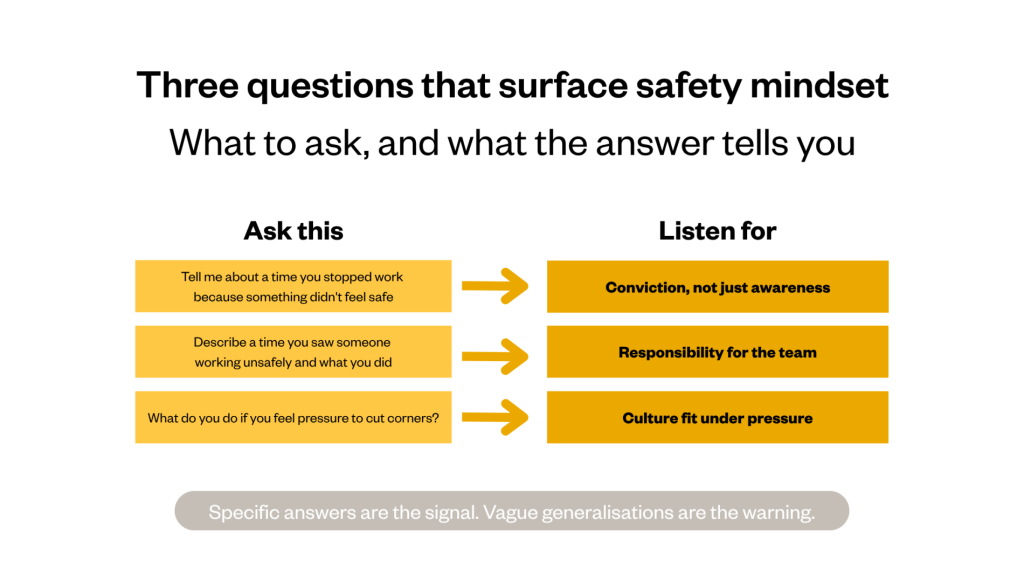
Questions like “Tell me about a time you stopped work because something did not feel safe” reveal whether a candidate has the conviction to act on their instincts, not just the awareness to notice a hazard. “Describe a time you saw someone doing something unsafe and what you did about it” tells you whether they take personal responsibility for the safety of their team, not just themselves. “What do you do if you feel pressure to cut corners?” is where you find out whether the culture they come from aligns with the one you are trying to build.
Follow-up probes sharpen the picture further: who else was involved, what was the outcome, was there formal reporting, and what would they do differently. Specific answers grounded in real experience are the signal. Vague generalisations are the warning.
Scenario testing adds a further layer. Presenting a trade-specific situation, such as asking an electrician how they would handle a confined space with unclear lockout and tagout status, shows you how a candidate thinks under pressure before they are standing in that situation on your site.
A structured rating across five dimensions, safety protocol awareness, initiative in identifying risks, willingness to speak up, experience with SWMS and JSA tools, and team communication, gives you a consistent, comparable assessment across every candidate, rather than relying on gut feel.
From our experience placing construction workers across Australia, the sites with the strongest safety records are the ones where safety is treated as a hiring criterion from the first conversation, not an onboarding checklist item after the contract is signed.
Download Our Free Safety Behaviour Interview Guide
To make structured safety screening practical for every hire, we have developed a free Safety Behaviour Interview Guide for construction employers. It includes the full question set, follow-up probes, and a five-dimension rating framework you can use consistently across labourers, trades, supervisors, and site management roles. Download it below and use it on your next hire.
At Frontline Construction, we work with builders, subcontractors, and project teams across Australia to find the right people for site, supervisory, and management roles. If you want to build a team that performs and a site that is safe, we would like to be part of that conversation.
Sources: Safe Work Australia, Key Work Health and Safety Statistics Australia 2025 · Build Australia, Australian Workplaces Are Becoming Safer in 2026, February 2026 · Institute of Trade and Further Education, WHS Trends 2026: Key Work Health and Safety Data Australia, April 2026 · Frontline Construction Recruitment, Safety Behaviour Interview Guide 2026