
5 Resume Tips for Allied Health Workers That Get You Noticed in a Competitive Market

Because in a sector this busy, your resume still needs to work hard.
Allied health is one of the most in-demand corners of the Australian job market right now. According to Jobs and Skills Australia’s 2025 Occupation Shortage List, healthcare remains the single largest source of shortage occupations nationally, with physiotherapists, occupational therapists, and speech pathologists sitting on the shortage list across most states and territories. According to Jobs and Skills Australia’s March 2026 data, the national vacancy fill rate for allied health has fallen to 68.2%, meaning nearly one in three roles is going unfilled.
That is good news if you are a clinician looking for your next role. But high demand does not mean every resume gets a call. Employers in this market are still making fast, selective decisions, and a resume that does not clearly communicate your qualifications, registration, and clinical track record will still get passed over.
Here are five things that will make yours stand out.
1. Lead With Your Registration and Accreditation Front and Centre
In allied health, your professional registration is not a footnote. It is the first thing an employer needs to confirm before they read anything else. Your AHPRA registration number, Medicare Provider Number if applicable, and NDIS Worker Screening Clearance should all appear clearly at the top of your resume alongside your contact details.
Do not make a hiring manager search for this information. Anything that slows down the screening process works against you, especially when employers are moving quickly to fill critical roles.
2. Write a Summary That Speaks to Your Specialty and Setting
A generic professional summary wastes the most valuable real estate on your resume. Allied health is not one profession. A physiotherapist specialising in paediatric rehabilitation and an occupational therapist working in aged care NDIS settings are entirely different candidates, and your summary should reflect that immediately.
Lead with your profession, your years of experience, your specialty or focus area, and something that signals your clinical approach. An example that works: “Dedicated occupational therapist with seven years of experience in community-based NDIS settings, skilled in functional capacity assessments, treatment planning, and interdisciplinary collaboration. Experienced in delivering evidence-based interventions aligned with current NDIA pricing and compliance requirements.”
That summary tells an employer exactly who you are and whether you fit the role before they reach your work history.
3. List Your Certifications and Professional Development Specifically
Employers hiring allied health professionals are looking for clinicians who invest in their own growth. CPR certification, Mental Health First Aid, Manual Handling Training, Motivational Interviewing, Trauma-Informed Care workshops, and advanced therapy skills training all belong on your resume with the year completed.
This is particularly important for NDIS-funded roles, where knowledge of current NDIA pricing, compliance, and participant support frameworks is increasingly expected rather than optional.
4. Quantify Your Clinical Outcomes Where You Can
Allied health resumes frequently describe responsibilities rather than results. The candidates who stand out are the ones who can show what their work actually delivered.
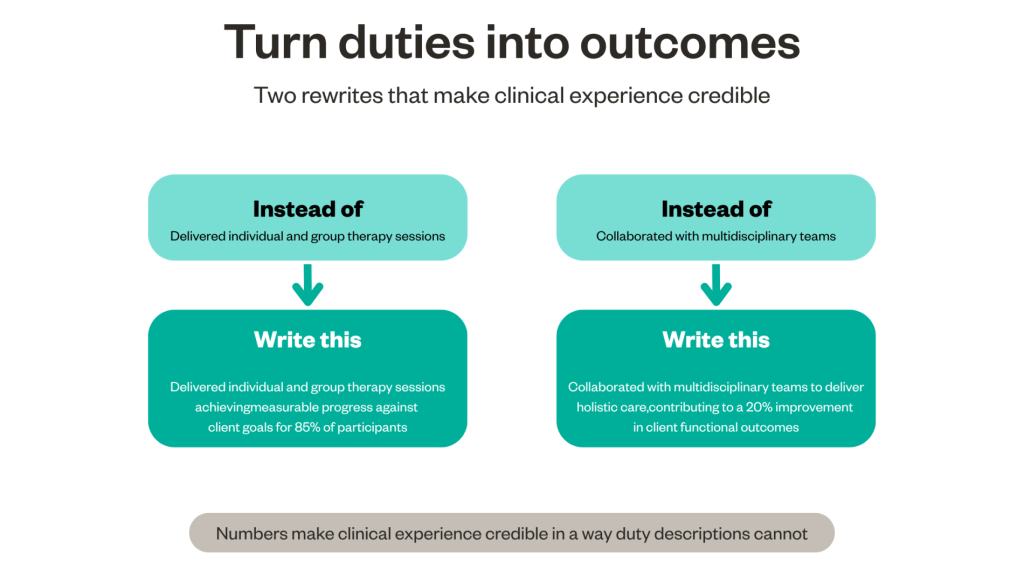
Instead of “delivered individual and group therapy sessions,” write “delivered individual and group therapy sessions achieving measurable progress against client goals for 85% of NDIS participants.” Instead of “collaborated with multidisciplinary teams,” write “collaborated with multidisciplinary teams to deliver holistic care, contributing to a 20% improvement in client functional outcomes.”
Numbers make clinical experience credible in a way that duty descriptions cannot.
5. Include Cultural Competency and Community Experience
According to the NSW Government’s December 2025 announcement of a $17.9 million investment to recruit paediatric allied health professionals across 15 local health districts, the roles most urgently needed include professionals with demonstrated experience working with diverse communities. Cultural competency and understanding of Aboriginal and Torres Strait Islander health needs is increasingly listed as a required rather than desirable skill across both public and community-sector roles.
If you have this experience, it belongs prominently on your resume. If you have completed relevant cultural safety training, include it in your professional development section with the year completed.
From our experience placing allied health professionals across Australia, the candidates who move fastest through the hiring process are the ones whose resumes are specific, registration-ready, and easy to scan. A well-structured resume does not just get you the interview. It signals that you are already the kind of organised, detail-oriented clinician an employer wants on their team.
Download our free Allied Health Worker Resume Template to structure your experience in a format that reflects your full clinical value.
At Frontline Health, we place allied health professionals across Australia in roles that fit their specialty, their lifestyle, and where they want their career to go. If you are ready for your next move, we would like to help.
Sources: Jobs and Skills Australia, Occupation Shortage List 2025 · Jobs and Skills Australia, Allied Health Vacancy Fill Rate, March Quarter 2026, cited in ASR Recruitment, What Is Really Driving Allied Health Hiring Challenges in Newcastle, 2026 · NSW Government, $17.9 Million Investment in Paediatric Allied Health, December 2025 · Academically, Physiotherapist Demand in Australia 2026 · Globe Healthcare, Occupational Therapy Shortage in Australia: Which States Need OTs, 2026 · Frontline Health, Allied Health Worker Resume Template 2026