
How Technology Is Reshaping Healthcare Workforce Planning and What Employers Need to Do Now
The organisations winning the talent race in Australian healthcare are not just hiring differently. They are planning differently.
The pressure on Australia’s healthcare workforce is structural and well documented. But something is shifting in how the best-run health organisations are responding to it. According to the Healthcare Australia Workforce Trends 2026 report published in September 2026, leading providers are now concentrating their strategic effort across five themes: AI-enabled productivity, workforce sustainability, digital transformation, governance and compliance, and margin protection, all without compromising care quality.
Technology is no longer a back-office consideration for healthcare employers. It has become the mechanism through which workforce strategy is built, staffed, and sustained.
Predictive Analytics Is Changing How Vacancies Are Managed
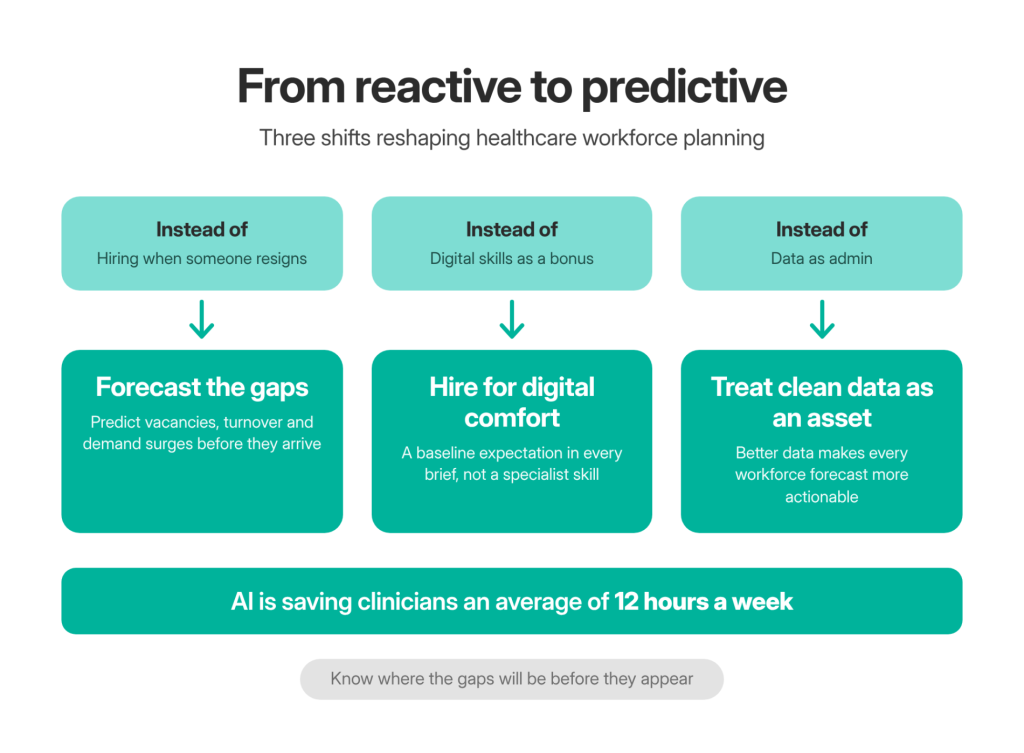
The reactive model of posting a role when someone resigns is giving way to something considerably more sophisticated. According to the Healthcare Australia Workforce Trends 2026 report, leading providers are now using predictive analytics to forecast vacancies, turnover, demand surges, overtime, and workforce cost before those pressures arrive rather than after.
According to First Line Software’s October 2026 analysis of Australia’s healthcare system challenges, the near-term lever available to health organisations is augmenting existing workforce capacity through clinical AI, automated workflows, and better digital tools, reducing the time clinicians spend on non-clinical tasks so clinical capacity stretches further. According to Vegavid’s 2026 analysis of AI in Australian healthcare, AI has reduced clinical administrative burdens by up to 45% in 2026, saving practitioners an average of 12 hours per week. That is 12 hours per clinician per week that can be redirected to patient care rather than documentation.
For healthcare employers, the practical implication is direct: workforce planning that does not incorporate data and forecasting is increasingly a competitive disadvantage, not just an operational inefficiency.
Digital Literacy Is Now a Hiring Criterion
According to Healthcare IT News’s reporting on digital workforce development, senior health leaders are now calling explicitly for more clinicians with digital health skills, more data scientists, and more technologists with an understanding of health. The mix of skills required across healthcare roles is shifting, and employers who are not factoring digital capability into their hiring briefs are narrowing their own talent pool unnecessarily.
According to the Healthcare Australia Workforce Trends 2026 report, digital platforms are now giving providers end-to-end ways to manage their workforce seamlessly, but the technology is only as effective as the people using it. A workforce that cannot engage with digital tools limits the return on every platform investment a facility makes.
This does not mean every nurse or allied health professional needs to be a data scientist. It means that digital comfort, the ability to work within digital systems, contribute to data quality, and adapt as tools evolve, is now a baseline expectation rather than a specialised skill.
Clean Data Is the Foundation Everything Else Rests On
According to the Healthcare Australia Workforce Trends 2026 report, what many providers are discovering is that AI effectiveness depends heavily on the quality of workforce, clinical, and operational data, meaning clean data is now an asset class worth investing in. Predictive models are only as useful as the information they run on. Facilities that have invested in data governance and interoperability are finding that their workforce analytics become meaningfully more actionable as a result.
According to the APAC digital health outlook published earlier in 2026, Australia is moving toward near-universal adoption of HL7 FHIR interoperability standards, which means the infrastructure for connected, data-driven workforce management is being built into the sector’s operating model at a foundational level.
From our conversations with healthcare employers across Australia, the facilities making the strongest hiring decisions right now are the ones that have moved beyond instinct and vacancy-filling into genuine workforce intelligence. They know where their gaps will be before they appear, they know which roles digital tools can stretch, and they know what capabilities they need to hire for next.
At Frontline Health, we work with healthcare employers across Australia to find the right people for the roles that matter most, in an environment that is changing faster than most hiring processes have caught up with. If your workforce planning needs to evolve alongside the technology, we would like to be part of that conversation.
Sources: Healthcare Australia, Healthcare Workforce Trends 2026: What Australian Health Leaders Need to Know, September 2026 · First Line Software, Top 10 Australian Healthcare System Pain Points in 2026, October 2026 · Vegavid, The Definitive Guide to AI in Healthcare in Australia 2026 Edition · Healthcare IT News ANZ, Building a Digital-Literate Workforce in Healthcare · Healthcare IT News APAC, What’s Next for APAC Digital Health in 2026 · Appinventiv, AI in Healthcare in Australia: Key Applications, Challenges and Future Trends 2026