
Why Job Security Is Winning the War for Talent in 2026

For a few years, flexibility was the thing candidates asked about first. In 2026, it’s slipped to second. What they’re asking now is whether the business will still be there, and whether their role will still exist, twelve months from now.
The Anxiety Is Real, and It’s Showing Up in the Data
We’re seeing this shift directly in the conversations our consultants are having with candidates this year, more questions about company stability and team structure, fewer about perks. It’s backed by the numbers too. LinkedIn’s workforce research shows job security has jumped from fifth to third priority for Australian employees, behind only compensation and flexibility, and separate research from ADP found only one in four Australian workers currently believe their job is safe from being cut. New Zealand is feeling it just as sharply. The Westpac-McDermott Miller Employment Confidence Index fell to its lowest level in 22 years in the June 2026 quarter, with the drop in confidence spread across nearly every region, age group and income bracket.
Why This Is Actually an Opportunity for Employers
Here’s the encouraging part. Job security isn’t primarily about guaranteeing a job for life, it’s about honesty and visibility. Research from ELMO Software found organisational stability now ranks second only to pay when Australian employees choose who to work for, which means businesses that communicate clearly about where they stand don’t need to compete purely on salary to win good people. A candidate who understands your business’s direction, and where their role fits in it, will often choose that certainty over a slightly bigger number somewhere else.
How to Actually Offer It
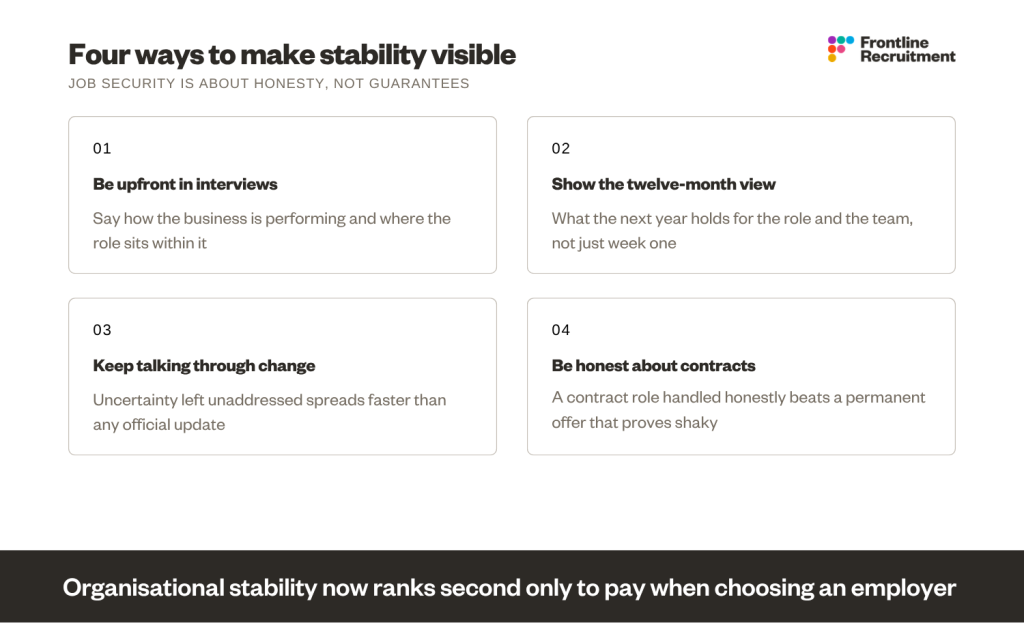
Be upfront in interviews about how the business is performing and where the role sits within it, rather than leaving candidates to read between the lines. Give new hires a genuine sense of what the next twelve months looks like for their role and their team, not just their first week. Keep communicating with your existing team through periods of change, since uncertainty left unaddressed spreads faster than any official update ever could. And where permanent stability genuinely isn’t possible right now, consider being transparent about that too, contract and interim roles handled honestly are often better received than a permanent offer that turns out to be shakier than it looked.
From our conversations with employers across Australia and New Zealand this year, the businesses attracting the best talent aren’t necessarily the ones paying the most. They’re the ones being straight with candidates about what they’re walking into and following through on it once they’re in the door.
At Frontline Recruitment, we help employers communicate that stability clearly to candidates from the very first conversation, because trust built early is what keeps good people around. If you’re hiring in the second half of 2026 and want to stand out for the right reasons, let’s talk.
Sources: LinkedIn Talent Solutions, Workforce Confidence research · ADP Research Institute, People at Work 2026 · ELMO Software, Employee Sentiment Index, August 2026 · Westpac-McDermott Miller Employment Confidence Index, June 2026