
Your Industry Experience Is Exactly What Australian and New Zealand Schools Are Looking for Right Now

If you have spent a decade in business, science, engineering, health, or any other field, teaching needs you more than you might realise.
Something significant is shifting in the way Australia and New Zealand are thinking about who becomes a teacher. For years, the pathway into the classroom was assumed to run through a school leaver completing a four-year education degree before entering the profession in their early twenties. That assumption is being actively dismantled, and the people benefiting most are mid-career professionals who never thought teaching was an option for them.
According to Education Matters Magazine’s March 2026 reporting on Teach For Australia’s latest intake, 52% of the 2026 cohort are mid-career professionals who graduated from another field more than five years ago. They are coming from business, science, engineering, mining, health, and the creative arts. According to AITSL’s June 2026 National Trends Teacher Workforce report, around 21% of early career teachers nationally are now aged 40 or over. This is not a niche trend. It is a structural shift in how both countries are building their teacher pipelines.
And schools are noticing the difference.
Why Schools Want What You Already Have
According to Teach For Australia CEO Edwina Dohle, cited in The Educator K/12’s April 2026 workforce analysis, career changers bring a wealth of real-life experience and real-world application that boosts student engagement and understanding. Students are more motivated when lessons connect to practical knowledge. A former engineer teaching mathematics, a nurse teaching biology, a business analyst teaching economics: these teachers bring a credibility and contextual depth that is genuinely difficult to manufacture in a graduate who has never worked outside a university.
According to UNSW’s 2026 career change to teaching guide, over 58% of Australian public school principals report teacher shortages, more than double the OECD average. In New Zealand, according to the New Zealand Ministry of Education’s Education Workforce website, the country actively encourages career changers across all sectors, with specific shortages in science, technology, maths, and secondary specialist subjects.
Your subject-matter expertise is not a consolation prize in lieu of teaching experience. In the current market, it is a competitive advantage.
What the Financial Support Actually Looks Like
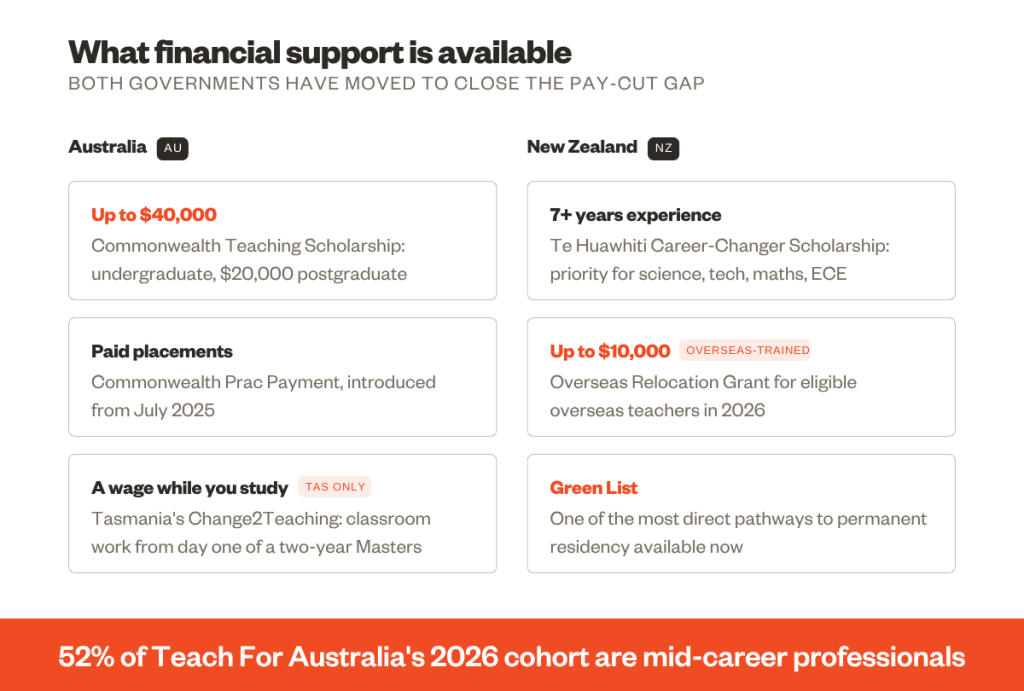
One of the most persistent barriers to career change into teaching is financial. Taking a pay cut to start at the bottom of a new profession is a real consideration, particularly for professionals in their thirties or forties with mortgages and families. Both governments have moved to address this directly.
In Australia, the Commonwealth Teaching Scholarships Program provides up to $40,000 for new undergraduate teaching students and $20,000 for postgraduate students, with 5,000 scholarships being awarded across five rounds from 2024 to 2028. The Commonwealth Prac Payment, introduced from July 2025, provides additional financial support during teaching placements. In Tasmania, the Change2Teaching program, launched in June 2026, goes further still: participants are paid a wage while completing a two-year Masters of Teaching, splitting their time between study and working in a classroom from day one.
In New Zealand, the Te Huawhiti Career-Changer Scholarship is available to professionals with at least seven years of work experience who are transitioning into teaching, with priority given to those planning to teach science, technology, maths, or early childhood education. According to AJV Global’s April 2026 guide to teaching in New Zealand, eligible overseas teachers are also able to access an Overseas Relocation Grant of up to $10,000 in 2026 to cover moving costs, flights, and registration fees. For those seeking long-term residency, teaching sits on New Zealand’s Green List, offering one of the most direct pathways to permanent residency currently available.
What the Classroom Looks Like at This Stage of Your Career
The practical reality of switching to teaching in your thirties or forties is different from entering the profession straight from university, and mostly in ways that work in your favour.
You already know how to manage competing priorities, communicate with difficult stakeholders, and deliver results under pressure. You understand what students are being prepared for because you have lived and worked in that world. You are, in most cases, more settled in yourself and more resilient than a twenty-two-year-old navigating their first professional environment.
According to the NSW Department of Education’s mid-career pathways initiative, the government is actively removing barriers to entry for professionals with relevant subject-area experience, recognising that the traditional qualification pathway has become unnecessarily restrictive for people who already bring substantial real-world expertise.
From our experience working with schools across Australia and New Zealand, the career-change teachers who thrive are the ones who come in with both humility and confidence: humility about learning the craft of teaching, and confidence in the knowledge and experience they bring to the classroom from day one.
Ready to Explore the Pathway?
At Frontline Education, we work with schools across Australia and New Zealand who are actively seeking teachers with diverse professional backgrounds. If you are considering a move into teaching and want to understand what the pathway looks like for your specific background and location, we would like to have that conversation.
Sources: Education Matters Magazine, Career Changers Helping Fill Australia’s Teacher Shortage, March 2026 · The Educator K/12, Why Mid-Career Teachers Are Most at Risk of Leaving, April 2026 · Australian Institute for Teaching and School Leadership, National Trends Teacher Workforce, June 2026 · UNSW Sydney, Making a Career Change to Teaching, 2026 · ABC News, Mid-Career Professionals to Make Teaching Switch Under New Tasmanian Program, June 2026 · Australian Government Department of Education, Commonwealth Teaching Scholarships Program · New Zealand Ministry of Education Education Workforce, Changing to a Teaching Career · New Zealand Ministry of Education Education Workforce, Te Huawhiti Career-Changer Scholarship, July 2026 · AJV Global, Your Guide to Becoming a Teacher in NZ, April 2026