
Why Do Performance Reviews Matter More in a Quiet Job Market? A Retention Guide for NZ Healthcare Employers

Quiet markets are when the best employers pull ahead. Job ads are up 7.8% on last year, but plenty of people are sitting tight, waiting to see where things land before they make a move. For employers, that creates a rare window.
When fewer people are moving, you get time you don’t usually have. It’s time to find out who’s genuinely happy, who’s quietly restless, and what it would take to keep your best people for the long haul. Some of your team are staying because they love where they work. Others are staying because now doesn’t feel like the right time to go. Knowing the difference is the edge.
That’s why the performance review matters more right now, not less. Whether you employ GPs, nurses, allied health professionals, mental health workers, or the admin teams that keep everything running, it’s the most valuable retention tool most healthcare employers already have.
Why do performance reviews matter more when the job market is quiet?
When fewer people are changing jobs, employers have a rare chance to understand who’s genuinely engaged and who’s simply waiting. A well-run performance review is the most structured, expected moment to have that conversation, and to give good people a reason to stay before the market picks up.
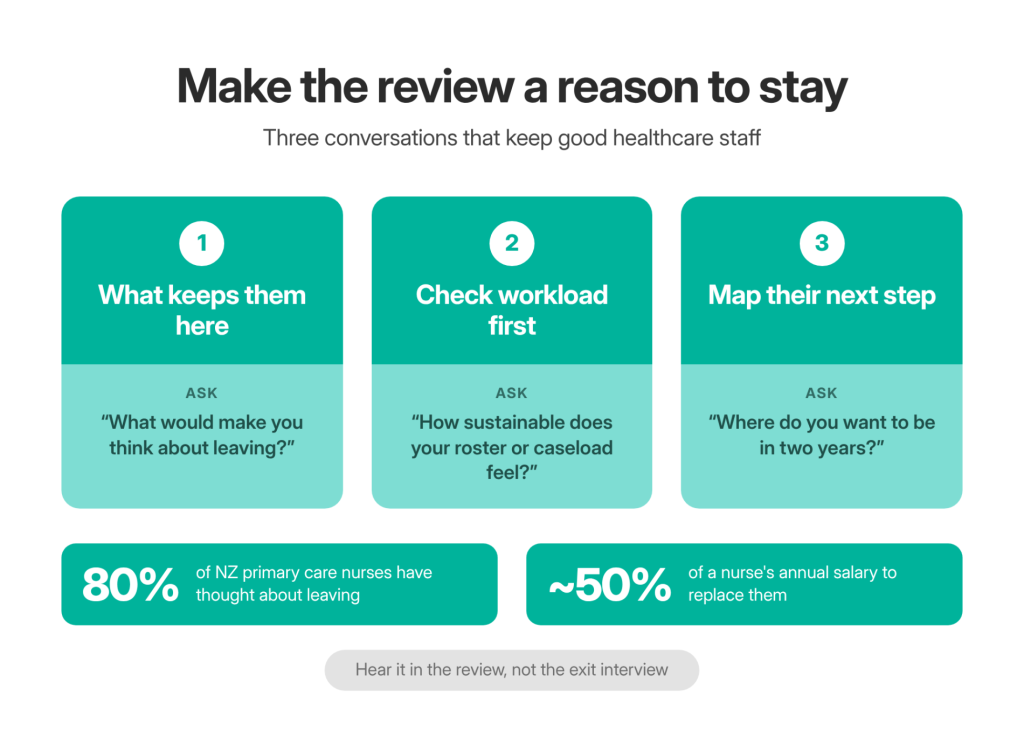
Across the health workforce, that conversation is overdue, and it isn’t limited to one profession. A March 2026 University of Otago study found almost 40% of Health NZ physiotherapists intend to leave their current job. In a December 2025 NZNO survey, 80% of primary care nurses had thought about leaving in the previous six months. And a 2026 review of New Zealand health workforce research found intention to leave was highest among midwives, at 54%.
Thinking about leaving isn’t the same as leaving, and that’s the opportunity. Someone who’s weighing up their options is someone you can still keep. The employers who use this period well won’t just hold onto their teams. They’ll come out of it with stronger loyalty, clearer career paths and a reputation as a place people want to stay.
How much does it cost to replace a healthcare worker in New Zealand?
More than most employers budget for. New Zealand research put the cost of replacing a nurse at around half their annual salary, roughly $30,000 at the time. For specialist roles that are harder to fill, from GPs and pharmacists to sonographers and physios, the cost and the time it takes are usually higher again.
Health NZ’s own workforce estimates have flagged shortages across a wide range of professions, not just nursing and medicine. So even with plenty of people applying for jobs right now, experienced health professionals who fit your team and your culture are still worth their weight in gold. Keeping a great person will almost always be faster and cheaper than finding a new one.
Why don’t most performance reviews improve retention?
Most performance reviews are designed for compliance, not connection. Gallup found only 14% of employees strongly agree their reviews inspire them to improve (2019). If the review only looks backwards, it misses the conversation that actually keeps people.
In healthcare, the annual review can easily become a checklist: competencies signed off, mandatory training ticked, CPD and registration requirements checked. All of that matters. But none of it tells you what your best physio, GP, support worker or practice manager wants from the next two years, or whether they see that future with you.
What should a performance review cover to keep good staff?
A retention-focused review covers three things: what keeps the person in their role, whether their workload is sustainable, and what their next step looks like. Get those right and the review becomes a reason to stay, not a box to tick.
Ask what keeps them here
“What do you enjoy most about working here?” and “What would make you think about leaving?” are two of the most useful questions in any review. Ask them while you can still act on the answers. It’s far better than hearing them for the first time in an exit interview.
Check in on workload first
It’s hard to talk about development goals with someone who’s running on empty. In the RNZCGP’s 2024 Workforce Survey, 70% of GPs rated themselves moderately to highly burnt out, and workload pressure shows up across clinical and non-clinical roles alike. Start with how sustainable their roster, caseload or workload feels. It shows you’ve noticed, and it gives you something concrete to fix.
Map out their next step
When fewer people are moving externally, growing internally becomes the big drawcard. Use the review to talk about what’s next. That might be extended scope or specialist training for a clinician, supervising students or graduates, a team leader role, or a move into clinical education or practice management. People stay where they can see a future.
How often should healthcare employers run performance reviews?
An annual review is the minimum, but short quarterly check-ins make the biggest difference. Gallup found 80% of employees who received meaningful feedback in the past week were fully engaged. Regular, lighter conversations surface issues early, while they’re still easy to fix.
For busy healthcare teams, a 15-minute quarterly check-in focused on the three questions above is realistic, and it means the annual review holds no surprises for anyone.
How can healthcare employers get ahead before the market picks up?
Use this quieter period to have honest conversations with your whole team. When hiring picks up again, the employers who’ve invested in their people will be the ones who keep them, and the ones great candidates want to join.
Performance reviews done well aren’t an HR formality. They’re how you build loyalty, plan careers and make sure the people you’ve invested in are still with you when the market moves.
At Frontline, we help healthcare employers find great people and keep them, across clinical, allied health, support and admin roles. If you’d like a fresh perspective on retention or your next hire, let’s talk.
Sources
- SEEK NZ Employment Report, September 2026
- University of Otago, workforce profile and turnover intentions of Health NZ physiotherapists, New Zealand Journal of Physiotherapy, March 2026
- Kaitiaki Nursing New Zealand / NZNO, primary health care member survey, December 2025
- Clarke, M. et al., attrition and intention-to-leave among healthcare workers in New Zealand: systematic review and meta-analysis, Journal of the Royal Society of New Zealand, 2026
- Health NZ | Te Whatu Ora workforce shortage estimates, via RNZ, July 2023
- Royal New Zealand College of General Practitioners, 2024 Workforce Survey
- North, N. et al. (2013), cost of nurse turnover in New Zealand, as cited in Kaitiaki Nursing New Zealand, 2026
- Gallup, More Harm Than Good: The Truth About Performance Reviews (2019) and How Effective Feedback Fuels Performance (2022, updated 2024)